
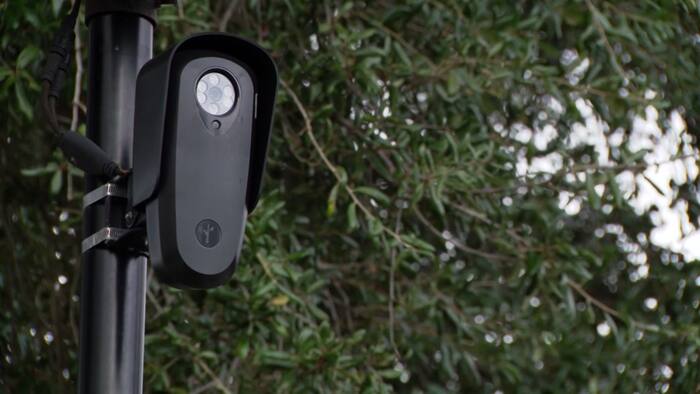
League City officials are moving forward with plans to remove the city’s Flock Safety license plate reader cameras after voters rejected their continued use in Tuesday’s election, with Mayor Nick Long calling for the cameras to be covered immediately.
In a statement Wednesday, the city detailed how it plans to carry out the voters’ decision, including a deadline for removing the cameras, restrictions on further data collection and a review of its existing agreements with Flock Safety.
The city said it will follow a resolution approved by City Council in October requiring its automated license plate reader cameras along public roadways to be removed within 72 hours after the official election results are canvassed at the council’s Nov. 17 meeting.
However, residents could see changes much sooner.
Long has asked city staff to immediately cover or “bag” the cameras, preventing them from collecting additional license plate information while officials work toward their removal.
Once covered, the cameras will no longer be able to collect data or share new information with outside agencies, according to the city.
According to League City officials, information previously collected by the police department’s license plate readers is automatically deleted from its system after 30 days unless it has been preserved as evidence in an active case.
The city said information previously shared with outside agencies is also retained for 30 days unless preserved as evidence in an existing case.
That means covering the cameras will stop new data collection, but it will not necessarily result in the immediate deletion of information already gathered.
The city must also address its existing contractual obligations with Flock Safety, the company that provides the camera technology.
Under the resolution, the city manager must review the agreements and pursue options including contract amendments, partial termination, nonrenewal or negotiated termination.
City staff will also coordinate the return of equipment, closure of accounts and any remaining financial obligations.
Any termination agreement or expenditure requiring City Council approval will be brought back to council for consideration.
The city has not yet announced how much it may owe Flock Safety or whether ending the agreements early would result in additional costs.
The resolution also addresses license plate reader cameras installed or operated by homeowners associations within city-controlled rights-of-way.
City staff must identify those cameras and notify the associations and equipment owners that they must be removed from city rights-of-way.
Unlike the city’s own cameras, the resolution does not establish a specific 72-hour removal deadline for homeowners association cameras.
Instead, officials must establish a deadline as soon as legally and logistically feasible while accounting for existing permits, licenses and agreements.
League City officials will also examine whether money previously allocated to the camera program can be redirected toward other public safety measures.
The city manager must identify available funds after accounting for any remaining contractual obligations.
Staff will then develop recommendations for alternative public safety spending based on community priorities and resident input.
No specific projects or funding amounts have been announced.
League City voters rejected Proposition A on Tuesday, signaling their opposition to the police department’s continued use of automated license plate readers at fixed locations along public roadways.
Although the proposition was nonbinding, City Council approved a separate resolution before the election outlining the steps officials would take it a majority of voters opposed continued use.
That resolution will take effect after the official canvass confirms the outcome, allowing the city to begin implementing the removal requirements without another council vote, except for actions that require separate approval.
Flock cameras automatically capture license plate numbers and other vehicle information, which police can use to identify vehicles potentially connected to criminal investigations.
Supporters have pointed to their usefulness, in solving crimes and locating missing people, while opponents have raised concerns about surveillance, privacy and the potential misuse of collected information.


